When
You have a clear object and a concise brief
Then
Use text generation for a fast concept or first-pass asset.
It is efficient for exploring silhouettes, themes, props, and variations before committing to detailed modeling.
3D creation explained
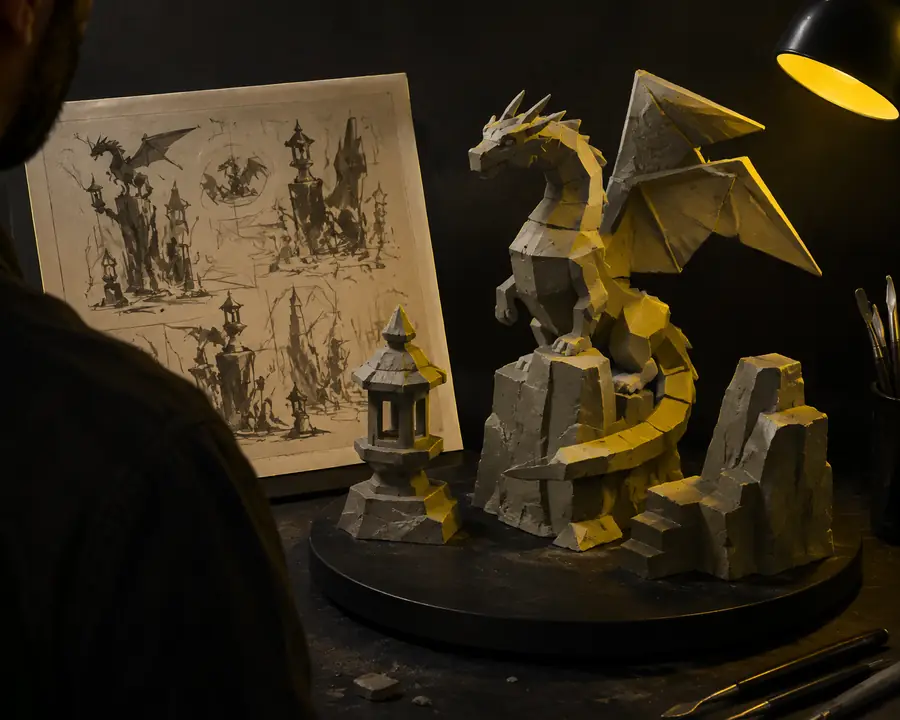
A text to 3d model workflow turns a written description into a structured object, usually by interpreting shape, materials, camera views, and style before generating editable geometry.
Before generative tools, a written idea was only a starting note. The actual model had to be built by hand, one decision at a time.
An artist converted words into references, proportions, sketches, and a list of visible details.
The mesh was modeled with primitives, sculpting, retopology, and repeated camera checks.
Materials, UVs, rigging, and exports were added before the object could enter a game, scene, or product workflow.
Modern tools shorten the distance between intent and geometry, while still leaving important creative and technical decisions to the user.
The fundamental goal stayed the same: turn intent into a usable object. What changed is where the labor happens and how quickly a first version can appear.
When
Then
Use text generation for a fast concept or first-pass asset.
It is efficient for exploring silhouettes, themes, props, and variations before committing to detailed modeling.
When
Then
Combine text with reference images and manual cleanup.
Additional visual evidence helps preserve important features that a general description may underspecify.
When
Then
Treat generation as the beginning, not the final step.
Topology, scale, materials, naming, collision, and performance still need review in the destination tool.
Text-driven creation is useful across different levels of experience, but each audience adopts it for a different reason.
A prompt may describe the right category while missing exact proportions, hidden surfaces, or a small defining feature.
WorkaroundAdd camera, material, shape, and scale details, then use reference images or edit the mesh.
A visually convincing model may contain dense, uneven, or difficult geometry that is unsuitable for animation or real-time use.
WorkaroundRetopologize, decimate, remesh, and test the asset in its final engine or DCC.
Generated variations can be plausible without matching a specific visual language, brand system, or gameplay requirement.
WorkaroundSet constraints early and curate outputs against a clear style guide.
Simple, recognizable forms are easier than transparent, articulated, highly reflective, or heavily mechanical subjects.
WorkaroundBreak complex subjects into parts and combine text, images, and conventional modeling.
The path from written description to 3D asset developed in stages, as each generation of tools moved more work from manual construction into guided automation.
Artists used written descriptions to plan references and production tasks, but the geometry itself was created manually.
Parametric and procedural tools allowed repeatable forms, yet users still had to define the structure and controls.
Machine learning made it practical to infer 3D structure from visual examples and experiment with language-guided concepts.
Browser-based AI tools made rapid object generation available to creators who did not want to begin with specialist modeling software.
The strongest workflow combines prompts with references, iteration, cleanup, format conversion, and testing for the final use case.
The visual difference is less about replacing every modeling task and more about moving the first useful draft much earlier in the process.
A generated model is a strong starting point when speed and exploration matter; final quality still depends on review, editing, and export preparation.